Municipality · Kardzhali Province
Kardzhali Municipality
Where it is, nature, what to see, getting there and history.

At a glance
- Province
- Kardzhali
- Administrative centre
- Kardzhali (town)
- Residents
- 62,005 (2021)
- Area
- 574.7 km²
- Settlements
- 118
- Elevation
- 290 m
- Municipal councillors
- 41 (2023)
- Mayor
- Erol Emin Myumyun (2023)
- Official website
- kardjali.bg
Information
Where it is
Kardzhali Municipality occupies the central and north-eastern part of the province of the same name. Almost all of its territory is in the Eastern Rhodopes; only the lands of the village of Nenkovo, in the north-western corner, belong to the Western Rhodopes. Its neighbours are the municipalities of Ardino, Chernoochene, Dzhebel, Momchilgrad and Krumovgrad, and to the east and north-east Stambolovo and Haskovo. The city of Kardzhali is built on both banks of the Arda river.
Nature and protected areas
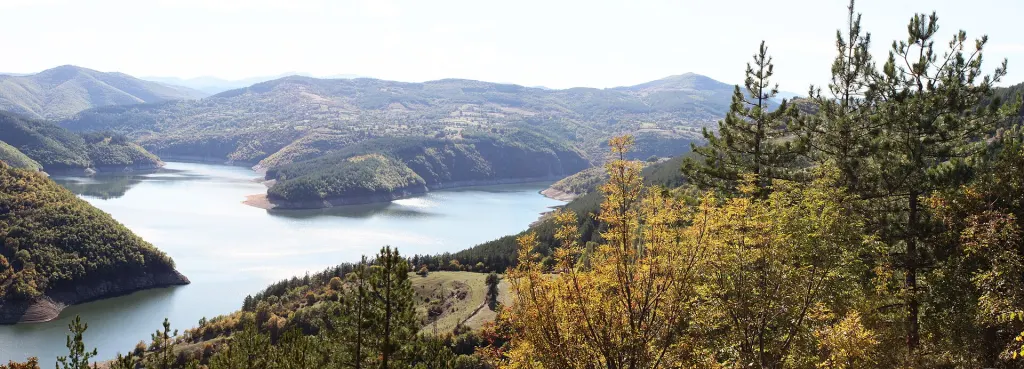
The terrain is hilly and low-mountainous, and the highest point is Bezdiven peak (1,140 m), south of Nenkovo. The Arda crosses the municipality from west to east and receives the Borovitsa, the Perperek, the Kyoshdere and the Varbitsa. Large parts of the Kardzhali Reservoir and the Studen Kladenets Reservoir lie here. The Stone Wedding, the Stone Mushrooms near Beli Plast and Skalniyat Prozorets (the Rock Window) near Kostino are protected as natural landmarks, and Venerin Kosam, Yumruk Skala and Sredna Arda as protected sites.
What to see
About 15 km north-east of the city, above the village of Gorna Krepost, rises the rock city of Perperikon, a cultural monument of national importance since 1968. In the city, the Regional History Museum, founded in 1965, presents the archaeology, ethnography and nature of the Eastern Rhodopes, including finds from Perperikon and Tatul. The Stanka Dimitrova Art Gallery holds icons, paintings and sculpture. The medieval Monastery of St John the Forerunner was restored in 2000 and is active again.
Getting there
The main road axis is the national road I-5, part of Trans-European Corridor 9, which continues south to the Makaza Pass and the Makaza – Nymfaia checkpoint on the border with Greece. The third-class roads III-507 and III-865 also cross the municipality, as does the Ruse – Stara Zagora – Dimitrovgrad – Podkova railway line. The city is about 50 km from Haskovo, 95 km from Plovdiv and 243 km from Sofia.
History
Antiquity
The oldest traces date from the New Stone Age: the city's museum keeps finds from Early Neolithic settlements in Kardzhali, dated to 5900–5700 BC. The rocks, niches and sanctuaries in the surrounding area bear the marks of the Thracian, Greek and Roman eras. In August 2000 a team led by the archaeologist Nikolay Ovcharov discovered a Thracian palace with sanctuaries from the 5th–4th centuries BC beneath the medieval fortress of Perperikon.
The Middle Ages and the Ottoman period
Around 847, under Khan Presian, the area became part of the Bulgarian state. From the 9th to the 14th century the Vishegrad fortress stood near today's Gorna Gledka quarter, and the Kardzhali Monastery of St John the Forerunner was the centre of a Christian diocese in the region of Ahrida. In 1370–1371 the local fortresses fell to the Ottomans under Murad I. According to legend, the settlement takes its name from Kardzha Ali, a commander in the campaigns of Murad I in the Rhodopes.
After the Liberation
On 3 January 1878 General Chernozubov's Russian detachment entered the area, but the Treaty of Berlin assigned it to Eastern Rumelia, and from 1886 it was again under direct Ottoman rule. Kardzhali finally became part of Bulgaria on 21 October 1912, after the battle near the town during the First Balkan War; the museum names General Vasil Delov as its liberator. The Lead and Zinc Works began operating in 1955, and from 1959 the city was a district centre.
Today
Since 1999 Kardzhali has been a provincial capital and the largest centre of the Eastern Rhodopes: administrative, industrial, commercial and cultural. The Lead and Zinc Works closed in 2012; the city is home to the production base of Teklas – Bulgaria, which makes rubber and plastic products. The Dimitar Dimov Drama and Puppet Theatre and the museum operate here, and the city hosts the Perperikon Arts Festival and the Petya Karakoleva Children's Literature Competition. The city's holiday is 21 October.
Mayors by term
| Term | Mayor | Party |
|---|---|---|
| 2023– | Erol Emin Myumyun | Movement for Rights and Freedoms (DPS) |
| 2019–2023 | Hasan Azis Ismail | Movement for Rights and Freedoms (DPS) |
| 2003–2019 | Hasan Azis Ismail | |
| 1999–2003 | Rumen Dimitrov Ivanov | |
| 1995–1999 | Rasim Musa Seidahmed | |
| 1991–1995 | Ismet Yasharov Saraliyski | |
| 1990–1991 | Milan Yordanov Milanov |
Cultural calendar
October
- Kardzhali Day – 21 October
Includes a vintage car and motorcycle parade.
- Perpera National Folk Dance Festival
Over 460 participants from 25 clubs.
November
- The Magical World of the Rhodopes, National Festival of Children's Art
Children's art competitions.
Sources
- bg.wikipedia: Kardzhali Municipality
- NSI, Territorial Statistical Bureau South: Population as of 7 September 2021 in Kardzhali Province (census 2021 by municipality)
- Local Self-Government and Local Administration Act (ZMSMA), Art. 19 (copy, cik.bg upload)
- Official municipal site
- Wikimedia Commons: Kardzhali_2011e_PD_09.jpg
- Kardzhali Municipality — Wikipedia (Bulgarian)
- Kardzhali — Wikipedia (Bulgarian)
- Kardzhali Municipality — History
- Regional History Museum — Kardzhali
- Regional History Museum Kardzhali — Kardzhali, the city
- Cultural calendar 2026 of Kardzhali Municipality not found; the events are from BTA (Bulgarian News Agency) (2025)
