Municipality · Plovdiv Province
Perushtitsa Municipality
Where it is, nature, what to see, getting there and history.

At a glance
- Province
- Plovdiv
- Administrative centre
- Perushtitsa (town)
- Residents
- 4,298 (2021)
- Area
- 48.7 km²
- Settlements
- 1
- Elevation
- 473 m
- Municipal councillors
- 13 (2023)
- Mayor
- Nikolay Georgiev Bakov (2023)
- Official website
- perushtitsa.egov.bg
Information
Where it is
Perushtitsa Municipality lies in the south-western part of Plovdiv Province, on the transition between the Upper Thracian Plain and the northern slopes of the Western Rhodopes, in the area known as the Rhodope Collar. It borders Stamboliyski to the northwest, Krichim to the west, and Rodopi Municipality to the east, south and southwest. The old part of Perushtitsa rises like an amphitheatre over the hills of Valkovishte and Vlasevitsa, at the foot of the Varhovrashki ridge.
Nature and protected areas
South of the town rises the Varhovrashki ridge, a continuation of Chernatitsa; its highest point is Sveti Georgi peak (1,191 m), west of the Bryanovshtitsa hut. The Vacha river flows along the north-western boundary, and the short streams from the mountains, the largest of which is the Perushtinska river, feed irrigation canals. The Peristitsa protected site, which also takes in part of the lands of Ustina, protects a rock massif, waterfalls and centuries-old beech and oak forest where the black stork nests.
What to see
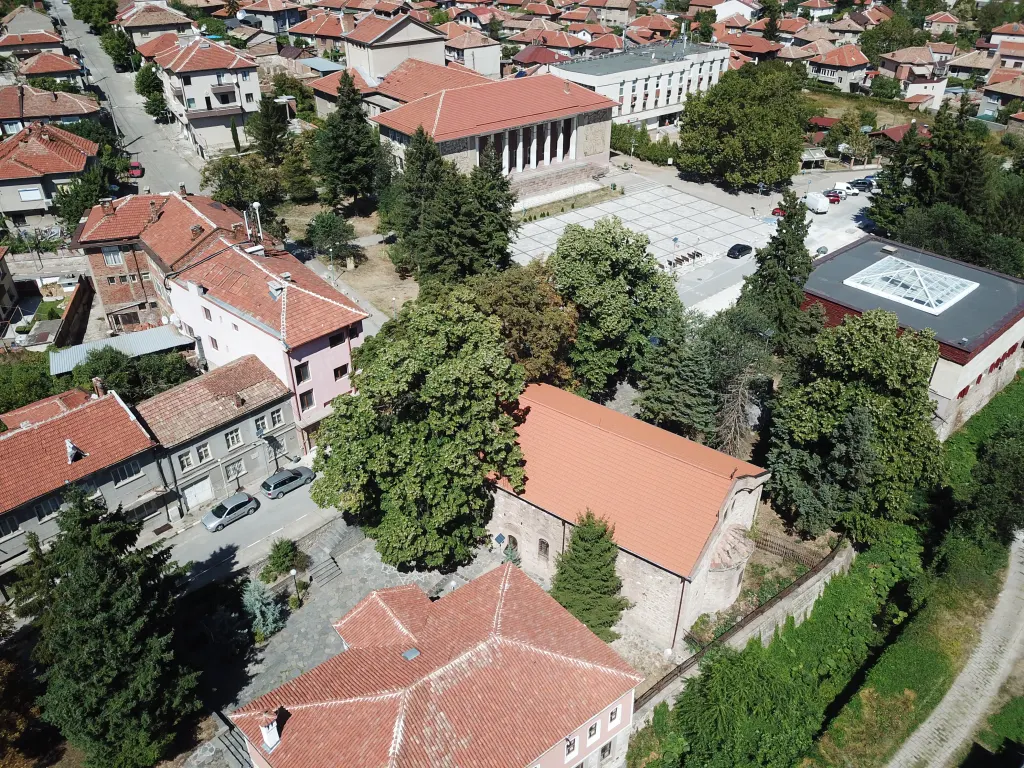
Between Perushtitsa and the Pastusha quarter stands the Red Church, the early Christian basilica of the Holy Mother of God from the 4th century, a monument of national importance. In the town centre is the Church of St Michael the Archangel, the insurgents' last refuge in 1876, which is today part of the History Museum; the museum is on the list of the 100 National Tourist Sites. The Revival-period school where Hristo G. Danov taught also belongs to the museum. On Vlasevitsa hill stands the Monument to the Three Generations.
Getting there
Perushtitsa lies southwest of Plovdiv, and the nearest town is Krichim. A section of national road III-8602 passes through the municipality. The Peristitsa fortress can be reached by car along the road that continues above the town towards Skobelevo and Churen, as far as a car park by the dirt track to the ruins of the monastery dedicated to Sts Theodore Tyron and Theodore Stratelates.
History
Antiquity
Near the Pastusha karst spring, remains have been found of a settlement inhabited from the Neolithic to the Bronze Age. Around the sacred spring and the rock sanctuary a Thracian settlement later grew up, which lived on into the Roman era. Burial mounds have been investigated in the surrounding area, among them Duhova, Banova, Gorkata and Andreeva. The Red Church was built around the middle of the 4th century, probably close to a pagan sanctuary of a large Thracian settlement. The wider context is in the article The Thracians in the Rhodopes.
The Middle Ages and the Ottoman period
The Peristitsa fortress, on a rocky hill about 2.6 km south of the centre, was founded by the Thracians, rebuilt in the Middle Ages and included in the defensive belt along the northern slopes of the Rhodopes, together with the Krichim fortresses and Ustina. The village is mentioned in an Ottoman register of the 16th century, and in the 17th century the people of Perushtitsa kept their Christian faith despite attempts at forced Islamisation. During the April Uprising of 23 April 1876 they defended themselves for seven days, finally in the Church of St Michael the Archangel.
After the Liberation
Perushtitsa was liberated on 3 January 1878 but under the Treaty of Berlin remained in Eastern Rumelia; its people were among the first to support the Unification in 1885. In 1929 the people of Perushtitsa founded the first tobacco growers' society in Bulgaria, and in 1935 the Napredak vine-growing and wine-making cooperative. In 1969 the village was declared a town, and by a decree of 1998 Perushtitsa separated from Rodopi Municipality to become a municipality in its own right.
Today
Livelihoods rest on vine-growing and wine, with the local Mavrud grape variety, on fruit-growing and on vegetable-growing; the town has a vocational high school of viticulture and wine-making. Perushtitsa keeps festivals of its own: on 20 January there is the Kapanki custom, in which newlyweds take a ritual bathe below the Cholakov Bridge; on 14 February the vines are pruned; and on 9 May the feat of the insurgents is commemorated. The Prosveta chitalishte (community centre) was founded in 1862 by Petar Bonev.
Mayors by term
| Term | Mayor | Party |
|---|---|---|
| 2023– | Nikolay Georgiev Bakov | Local coalition BSP for Bulgaria |
| 2019–2023 | Maria Asenova Vitanova-Valkanova | GERB |
Cultural calendar
January
- Kapanki
Men who married in the previous year jump into the icy river, most often from the Cholakov Bridge.
Sources
- bg.wikipedia: Perushtitsa Municipality
- Official website
- Commons: Centre of Perushtitsa
- Perushtitsa (municipality) — Wikipedia (Bulgarian)
- Perushtitsa — Wikipedia (Bulgarian)
- The Red Church — Perushtitsa History Museum
- Peristitsa Fortress — Perushtitsa History Museum
- The Church of Self-Sacrifice, St Michael the Archangel — Perushtitsa History Museum