Municipality · Pazardzhik Province
Peshtera Municipality
Where it is, nature, what to see, getting there and history.

At a glance
- Province
- Pazardzhik
- Administrative centre
- Peshtera (town)
- Residents
- 14,742 (2021)
- Area
- 158.4 km²
- Settlements
- 3
- Elevation
- 461 m
- Municipal councillors
- 21 (2023)
- Mayor
- Yordan Stoyanov Mladenov (2023)
- Official website
- peshtera.bg
Information
Where it is
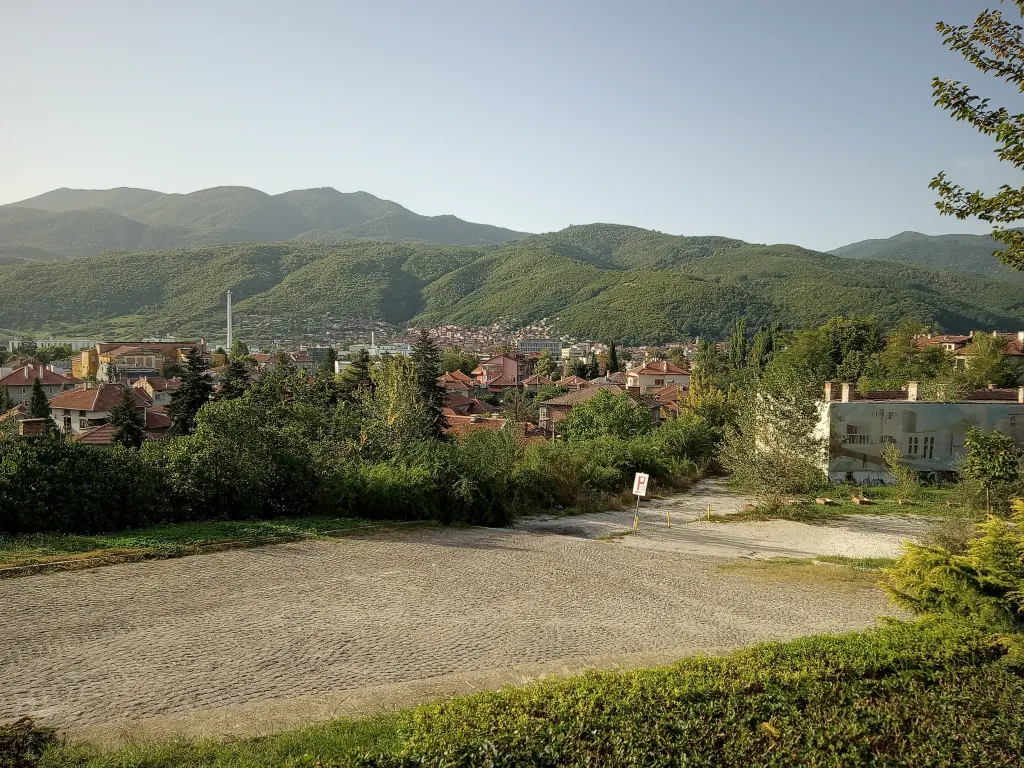
Peshtera Municipality is in the eastern part of Pazardzhik Province and lies entirely in the Western Rhodopes, where the mountains descend towards the Upper Thracian Plain. It borders Bratsigovo to the east, Batak to the south, Rakitovo to the west, and Pazardzhik Municipality to the north and north-west. The town of Peshtera lies at the foot of the mountains, close to Batak and Bratsigovo and 17 km from Pazardzhik.
Nature and protected areas
The Stara Reka river crosses the municipality from south-west to north-east in a deep gorge between the Karkaria ridge to the north-west and Ravnogor, the outermost ridge of the Batak Mountain, to the south-east. Kostina Mogila peak (1,440 m) in the Karkaria rises north-west of the Sveti Konstantin summer resort. Around 40% of the land is covered with forest. The Kupena Reserve lies 3 km south of the town and is rich in endangered plant and animal species.
What to see
The late antique and medieval Peristera fortress, known as the Dove Fortress, stands 0.8 km north of the centre of Peshtera; a museum has been set up in its southern tower. The Historical Museum occupies the former metochion (dependency) of the Krichim Monastery next to the church of St Petka, and the Professor Veselin Staykov gallery holds over 350 works. The town also has the Revival-period church of St Demetrius (1825–1831) and the clock tower, and 5 km to the south-west, in the Batak Mountain, is the Snezhanka Cave, one of the 100 National Tourist Sites.
Getting there
About 18 km of national road II-37 run through the municipality, and road III-375 also starts here. Peshtera is the terminus of the Stamboliyski – Krichim – Peshtera railway line, whose last section crosses the eastern part of the municipality. Pazardzhik, the provincial capital, is 17 km away, and from the junction near the town a road leads to the villages of Radilovo and Kapitan Dimitrievo.
History
Antiquity
The oldest traces of people around Peshtera date from the Neolithic, and finds show that in the Bronze Age people lived in the Snezhanka and Yubileyna caves. For millennia the Thracian tribe of the Bessi lived here, later under the influence of the Romans and the Byzantines. A settlement arose in the Peshtera basin in the second half of the 4th century BC. On Peristera hill there is what is probably a Thracian sanctuary with rock-cut steps, and in the surroundings are the remains of the Kievo Kale, Perun and Tamra fortresses.
The Middle Ages and the Ottoman period
The settlement is mentioned under the name Peshtera in a document of 1479, when it was part of the timar (fief) of one Mustafa. Of the several explanations of the name, the link with the caves around it prevails (peshtera is Bulgarian for cave). At the end of the 18th century Bulgarians from the Kostur villages of Omotsko and Oreshche founded the upper Gaber mahala (neighbourhood). During the Bulgarian National Revival, master builders of the Peshtera building school raised the churches of St Demetrius, St Petka and the Holy Mother of God; a secular Bulgarian school opened in 1848, and the Nadezhda chitalishte (community centre) in 1873.
After the Liberation
Russian troops liberated Peshtera on 6 January 1878: the town was taken by the company of Lieutenant Panin, and a company of the 123rd Kozlovski Regiment stayed on as its garrison. People from Peshtera had also taken part in the struggles before that, among them Dimitar and Atanas Gorov and Georgi Zafirov, while Georgi Stoilov, Nesho Chipev and Nikola M. Donski served in the Bulgarian Volunteer Corps (Opalchenie). In 1934 Alikochovo was renamed Kapitan Dimitrievo. In 1954 the plane tree was planted in front of the municipal building, and the House of Culture was founded in 1980.
Today
Today Peshtera is known for its shoe factories, for the Biovet pharmaceutical plant and for Vinprom Peshtera, which makes grape rakia and mastika bearing the town's name. Peshtera Day is 6 May, St George's Day, and on the last Saturday of July a folk fair is held at the Sveti Konstantin summer resort. The municipality points to climatotherapy, winter sports, ecotourism, hunting, fishing and caving as its opportunities.
Mayors by term
| Term | Mayor | Party |
|---|---|---|
| 2023– | Yordan Stoyanov Mladenov | Initiative committee of Yordan Stoyanov Mladenov |
| 2019–2023 | Yordan Stoyanov Mladenov | BSP for Bulgaria |
Cultural calendar
May
- Peshtera Day (town festival)
Town festival with festive fireworks and concerts.
July
- National Folklore Fair of Folk Art
A fair of folk art.
August
- International Ethnocultural Festival: The Culture of the Future and the Future of Culture
A festival of cultural heritage and intercultural exchange.
September
- National Festival of Keshkek and Folk Skills
A tourism festival with keshkek and crafts.
Sources
- Peshtera Municipality - bg.wikipedia.org
- Official website of Peshtera Municipality
- File:PeshterafromNorth001.jpg - Wikimedia Commons
- Peshtera (municipality) — Wikipedia (Bulgarian)
- Peshtera (town) — Wikipedia (Bulgarian)
- Peshtera Municipality — History
- Peshtera Municipality — Tourism
- Cultural calendar 2026 not found