Municipality · Smolyan Province
Zlatograd Municipality
Where it is, nature, what to see, getting there and history.

At a glance
- Province
- Smolyan
- Administrative centre
- Zlatograd (town)
- Residents
- 9,768 (2021)
- Area
- 171.5 km²
- Municipal councillors
- 17 (2023)
- Mayor
- Miroslav Mitkov Yanchev (2023)
- Official website
- zlatograd.bg
Information
Where it is
Zlatograd Municipality lies in the far south-eastern corner of Smolyan Province and belongs to the south-western parts of the Eastern Rhodopes. It borders Rudozem to the west, Madan to the north-west, Nedelino to the north, and Dzhebel and Kirkovo in Kardzhali Province to the east. Its southern boundary is the state border with Greece. Its centre is the town of Zlatograd.
Nature and protected areas
The territory consists of low and medium-height mountains and lies entirely on the southern and south-western slopes of the Zhalti ridge. The highest point is Buchovitsa peak (1,406.6 m) near the border with Madan, and the lowest is the bed of the Varbitsa where it leaves towards Kirkovo. The river, a right tributary of the Arda river, is formed in the town itself by the confluence of the Golyama and Malka rivers. Near the town is the Zlatograd Reservoir, and between Dobromirtsi and Benkovski rises the Gabata rock.
What to see
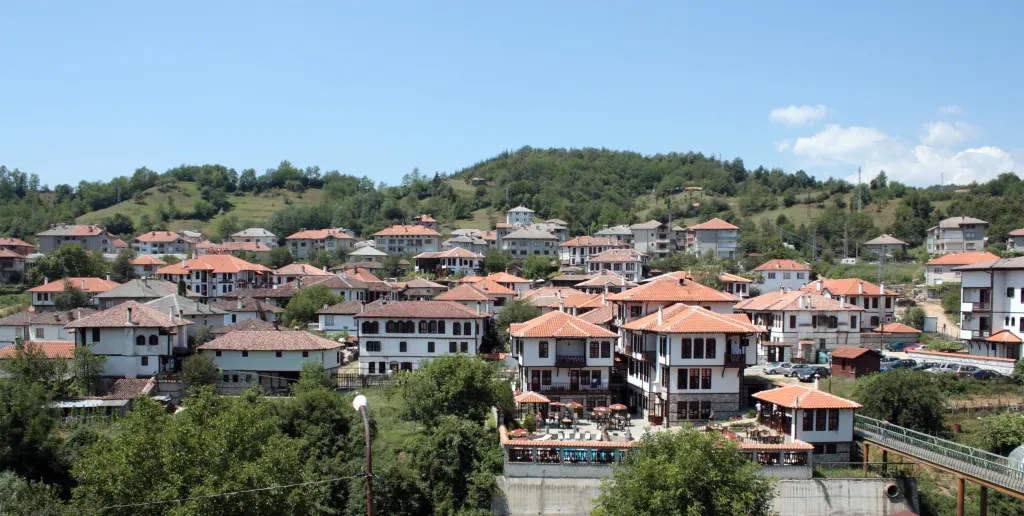
The heart of the town is the Ethnographic Areal Complex, with the ethnographic museum in the Aleksandrov houses and the Postal Museum, the only one in Bulgaria. The Church of the Dormition of the Virgin, dating from 1834, is the oldest Rhodope church from Ottoman times; the cell school stands in its courtyard. The mutual school at St George's is a museum of education in the Central Rhodopes. The town also has the Tabahnenska Mosque and the monument to Delyo Voyvoda, the hero of the song Izlel e Delyo Haydutin.
Getting there
The municipality is crossed by national road III-867 and also holds the last section of road III-8652. Near the town is the Zlatograd–Thermes border crossing, which shortens the way to Xanthi and the Aegean Sea. Zlatograd is also a gateway for walking routes in the Rhodopes — see the short and long routes.
History
Antiquity
In its first hall the ethnographic museum in Zlatograd displays archaeological finds from the area from Thracian times, from the period of Roman rule and from early Byzantium. Coins and pottery from the Thracian period are also kept in the museum collection at the Church of St Athanasius the Great. In all, 120 sites in Zlatograd are listed as architectural or archaeological monuments.
The Middle Ages and the Ottoman period
Until 1934 the settlement was called Daradere. Muslims, mainly Yuruks, have lived in the area since the 14th century, and the Christians here were called meroptsi. The song and legends link the area with the haiduk Delyo Voyvoda, from the turn of the 17th and 18th centuries. In the 19th century Daradere was a centre of the Bulgarian National Revival: the church of 1834, the cell school and the mutual school of 1852; in 1855 the teacher Angel Kiryakov took part in the teachers' assembly in Plovdiv.
After the Liberation
The area remained in the Ottoman Empire after 1878 and was liberated during the First Balkan War in 1912; Zlatograd still marks its liberation on 21 November. After 1912 Bulgarians from other regions settled in the town, and in 1913 Ilia Hadzhidonchev became the first mayor of Daradere. In 1934 the settlement received the name Zlatograd. Under socialism two mosques in the town were demolished, one of them in 1984.
Today
The economy rests on the Erma Reka mine, where lead-zinc ore is extracted, on textile production and on tourism around the ethnographic complex. The town is known for the song Izlel e Delyo Haydutin, which was sent into space in 1977 on the Voyager Golden Record. Every year there is a chevermeto (spit-roast lamb) festival and a folk fair on Kostadin peak in May, the Delyo Days in September and the K3 ultramarathon.
Mayors by term
| Term | Mayor | Party |
|---|---|---|
| 2023– | Miroslav Mitkov Yanchev | GERB |
| 2019–2023 | Miroslav Mitkov Yanchev | GERB |
| 2007–2019 | Miroslav Yanchev | GERB |
Cultural calendar
January
- Yordanov Den (Epiphany) — throwing of the cross
After a church service and a procession, young people retrieve a cross thrown into the river and carry it from house to house for blessing.
- Babinden (Midwives' Day) – Erma Reka (village)
A celebration of traditional midwives, organised by the mayoralty and the chitalishte (community centre).
February
- Trifoniada
A wine festival with a home-made wine competition, wine cellars and tasting.
- Sirni Zagovezni and Stara Marta
Jumping over a fire and a kukeri dance around the fire to drive away evil.
April
- Lazarovden (Lazarus Saturday)
A presentation of the lazaruvane custom and folk merrymaking.
May
- Zlatograd Chevermeto Festival
A celebration of hospitality and traditional chevermeto (spit-roast lamb), with gaida players.
- Dolen village festival
A village festival with the mayoralty and the Iskra – 1997 chitalishte.
June
- Tsvetna Pletenitsa International Folklore Festival
An international folklore festival of the Ethnographic Complex.
- Enyovden Folk Dance Festival – Startsevo
A dance festival of the Krasivo Startsevo association.
August
- Startsevo village festival
A village fair of the mayoralty and the Progres-1939 chitalishte.
- Erma Reka village festival
A village festival of the mayoralty and the Orpheus – 1947 chitalishte.
- Fire of Orpheus – summer academy
An international academy for young talent, with open concerts.
September
- Delyo Days
Exhibitions, books, sport and the re-enactment A Market Day 100 Years Ago.
- September Literary Days
Literary discussions and visits by Bulgarian authors.
October
- Balkan Skariada
A celebration of the grill, music and dances of the Balkan peoples.
November
- Zlatograd Day
A festive procession, wreaths and ceremonial fireworks.
December
- Switching on the Christmas tree lights
A Christmas celebration with the lighting of the tree.
Sources
- bg.wikipedia: Zlatograd Municipality
- Official site of Zlatograd Municipality
- Commons: View of Zlatograd centre
- Zlatograd (municipality) — Wikipedia (Bulgarian)
- Zlatograd — Wikipedia (Bulgarian)
- Zlatograd Municipality — Museums
- Official site of Zlatograd Municipality — Traditions section (English version)