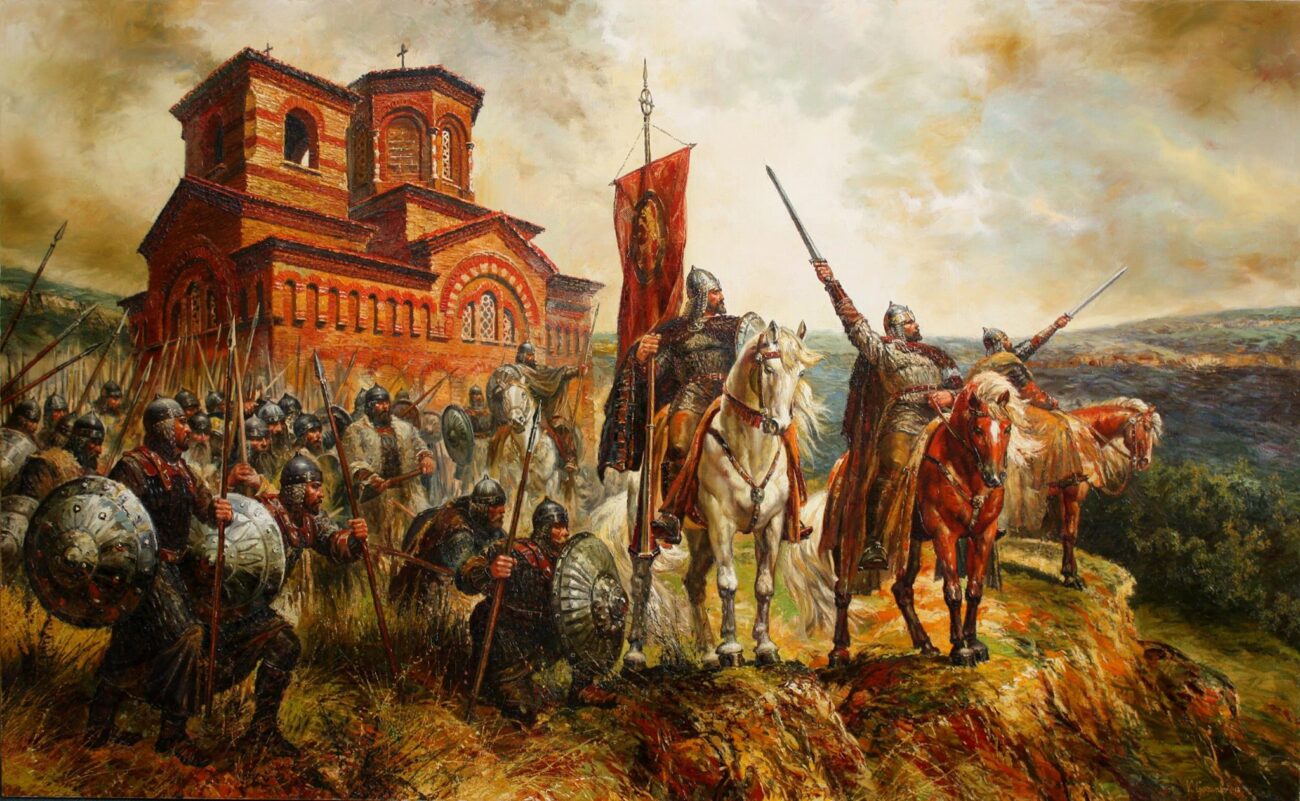
Byzantium could not reconcile itself to the loss of the Balkan Peninsula and soon began a life-and-death war with the Slavs.
A threat to Byzantium
The struggle with Byzantium sharply changed in character and ferocity after 680, when Asparuh's Bulgars arrived in the Balkan Peninsula and the first Slavic-Bulgarian state was formed north of the Balkan Mountains (on both sides of the Danube river). Now the Byzantine Empire faced an organised force that acted as a unifying centre for the Slavic tribes of Thrace, the Rhodopes and Macedonia. As long as Bulgaria was not destroyed, Byzantium could not feel master of the Balkan Peninsula.
But that was not all. Byzantium also had extensive plans of conquest towards the other Slavic tribes and peoples, both in the north-western part of the Balkan Peninsula and in Central Europe.
The Bulgarian state
The Bulgarian state, however, stood in its way. That is precisely why Constantinople did everything possible to crush Bulgaria. War followed war. Time and again Byzantine troops were sent on campaign towards the Balkan Mountains, but many armies also met their end in Thrace and in the passes of the Balkan Mountains. For their part, Bulgarian troops more than once found themselves beneath the walls of Constantinople and put the empire in an extremely difficult position.
Thus Bulgaria took the main blow of the wars with Byzantium upon itself and throughout the Middle Ages was the outpost of the Slavic peoples against a strong and dangerous enemy. In this it rendered undoubted service to the whole Slavic world.
In this centuries-long struggle the Bulgarian population of the Rhodopes was destined to play a particularly important role. Because of their important strategic position, the Rhodopes were a magnet for both states. Whoever held the Rhodopes would also hold Thrace, and the balance of power would be on their side. That is precisely why, immediately after the internal strife in the Bulgarian state was overcome in the 8th century, eyes turned south – towards the Rhodopes.
The incorporation of the Rhodopes
From the beginning of the 9th century Bulgarian troops more and more often criss-crossed Thrace and routed the Byzantine armies, until at last they drove them out of the Rhodopes and Macedonia for good. In 837 the western and central parts of the Rhodopes finally came within the borders of the Bulgarian state. Bulgaria reached the Aegean Sea, freeing most of Western Thrace from Byzantine rule. Two inscriptions of the Bulgarian Khan Presian, found near Philippi, north of Kavala, also survive from this time. One of them says that the liberation of the Rhodope tribe of the Smolyani was carried out by an army commanded by the kavhan Isbul. The second says that the Byzantines have forgotten the good the Bulgarians did them, but will not escape retribution for it.
At the same time the Slavic tribes in present-day Macedonia were also joined to the Bulgarian state. In this way Byzantine rule over the Rhodopes, the Aegean coast and Macedonia was ended. This happened with the active support of the local Slavic population.
The importance of the Rhodopes
The incorporation of the Rhodopes into Bulgaria made this region more important still. Lying closest to the borders of the Byzantine Empire, it was turning into an impregnable Bulgarian stronghold. Before launching any offensive towards Thrace and Moesia, the Byzantines had to think of the security of their rear. This meant overcoming and crushing the resistance of the Slavic population of the Rhodopes. So whenever the threat of foreign invasion hung over the Bulgarian political sky, the storm clouds appeared first over the Rhodopes and struck their first blows here. Here, however, the foreign invaders also met the first resistance of the Bulgarian state.
More than once the plans of conquest, not only of Byzantium but of many other claimants to the Bulgarian lands, were shattered on the impregnable Rhodope strongholds and the heroism of the local Bulgarian population.
In 1230 the Rhodopes witnessed new brilliant successes of Bulgarian arms. In the battle near the village of Klokotnitsa (Haskovo district), the treacherously invading armies of Epirus were routed. The Despot of Epirus himself, Theodore Komnenos, was taken prisoner, and his state ceased to exist. Bulgaria became the greatest power in the Balkan Peninsula and reached three seas – the Black Sea, the Aegean and the Blue Sea (the Adriatic).