Name
In the Rhodopes it is held in special esteem by the local people, who call it ak boba, that is, old father.
Description
- Body length is 60–70 (up to 85) cm.
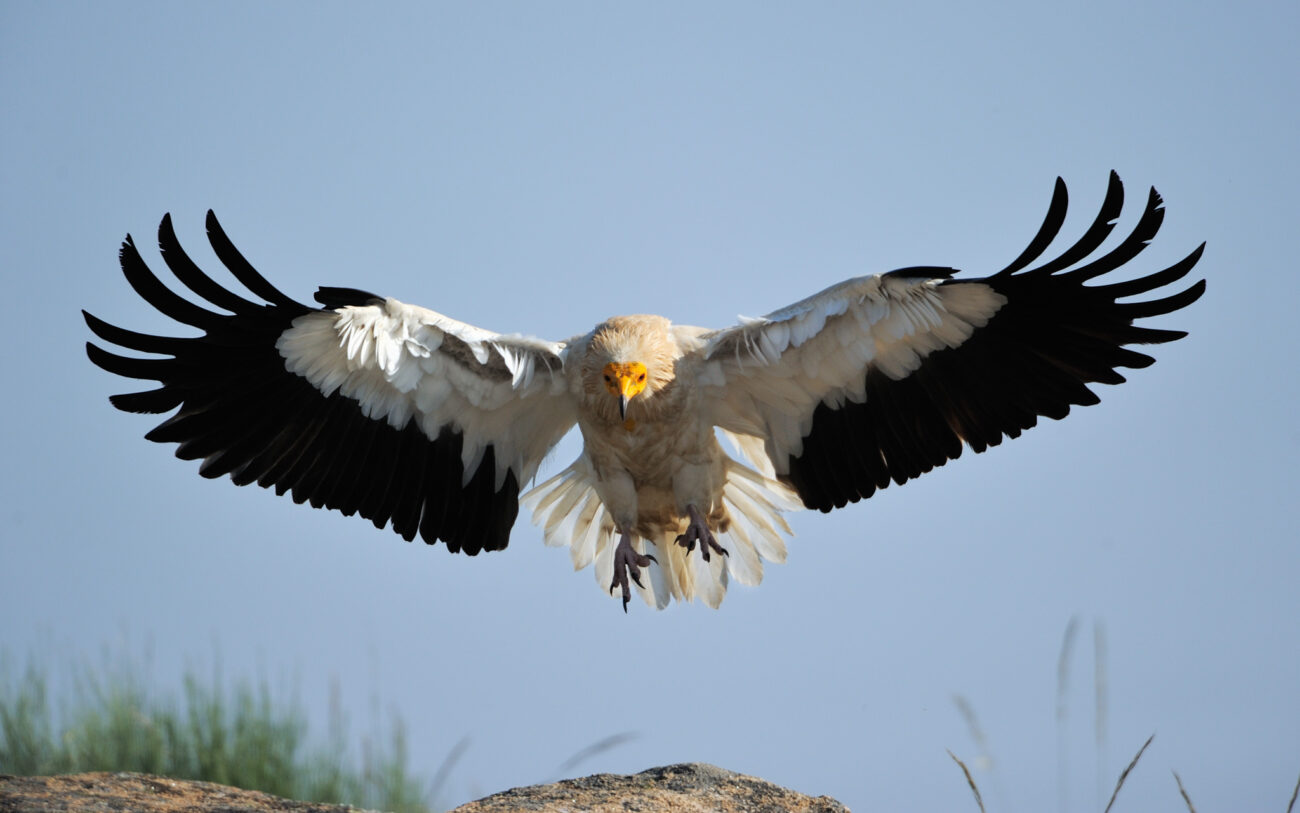
- Wingspan – 150–170 cm.
- Its weight reaches 1.6–2.5 kg.
Its plumage is dirty white, with black flight feathers. The face and throat are bare and yellow (in young birds they are almost black). The tail is relatively long and wedge-shaped, like that of the bearded vulture.
Distribution
It is found in Europe (including Bulgaria), Africa and Asia. It lives on volcanic rock massifs as well as in gorges and ravines and on rocky and loess banks. Unlike the other vultures, it winters in Africa.
Biology
On the ground it walks very confidently, like the gamebirds.
It feeds mainly on carrion, but sometimes catches small animals such as frogs and snails, and takes all kinds of eggs. It also eats tortoises and the eggs of large birds such as the ostrich (it uses a stone to break the eggs).
The Egyptian vulture is a monogamous bird. It nests on inaccessible cliffs and in caves. Both birds build the nest. It holds the bones of small animals, tortoise shells and the like. It carries nest material in its beak, unlike other birds of prey, which carry it in their feet. It lays two eggs a few days apart. Both parents take turns incubating for 40–42 days. The young leave the nest at about 70–96 days old. It raises one brood a year.