Name
The wolf has no other name in Bulgarian. The group that adult wolves form in the different seasons of the year is called a pack, while the young cubs, from birth until they leave their mother, form what is known as a kuchilo (litter), very often wrongly called a kotilo in members of the dog family.
Description
The wolf is a medium-sized mammal. It is the largest member of the dog family.
- Its body length reaches up to 150–160 cm, and its tail up to 30–35 cm.
- Height – up to 80–90 cm.
- In Bulgaria its body weight is usually 40–45 kg. Rare individuals reach 55–60 kg.
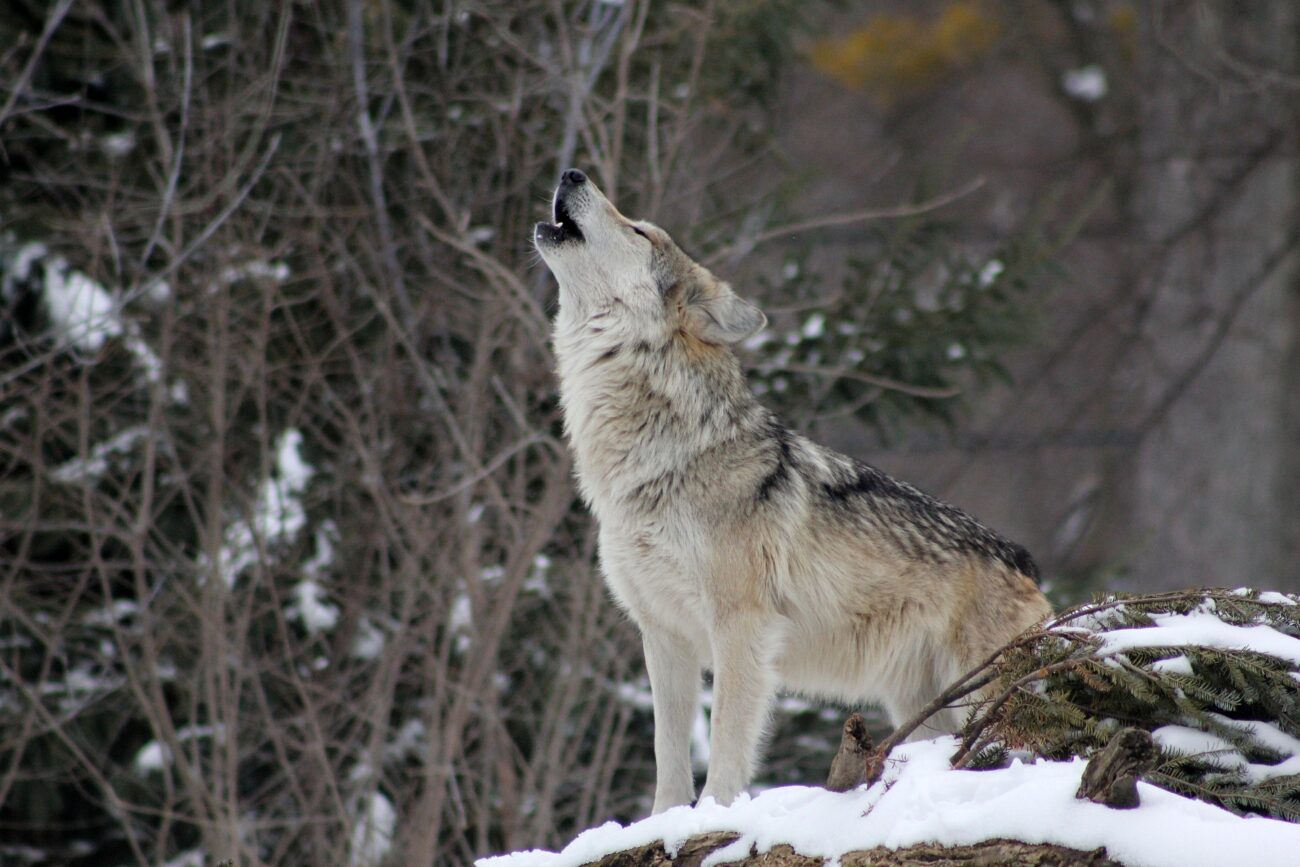
Its coat is mainly grey to greyish black on the back, while the belly and legs are lighter and often have a rusty tinge. The chest and neck are greyish white, sometimes pure white. Very rarely the coat is mainly another colour – rusty or black.
Distribution
In Bulgaria the wolf is found in all the mountains. It now also occurs in the country's lowland forests.
In the Rhodopes the wolf lives in every section of the range. In the Central and Western Rhodopes its numbers are traditionally high, with the most wolves in the Devin and Velingrad areas.
Its attachment to particular territories depends above all on the presence of cloven-hoofed game, which, together with domestic animals, is its main prey.
In the wild the wolf can be mistaken for a large sheepdog (a wolf-like breed), and younger, smaller wolves also for jackals. It can be told from a dog by its behaviour and its reaction when a person appears, and, at a great distance, when it has not sensed our presence, by its characteristic thick tail, which hangs down as if cut off.
Biology
The she-wolf gives birth to 4 to 8 cubs, rarely more. The cubs are blind and helpless. They open their eyes at 13 days. Both parents care for the young. The cubs grow fast. At one month old they come out of the den and begin to feed on their own: at first the parents regurgitate food they have eaten, and later they also bring them half-dead animals, on which the young learn to hunt, hold and kill.
The wolf is a bloodthirsty predator. It hunts in groups and in a well-organised way. Given the chance, it kills more than it needs to eat. In the Rhodopes its most frequent prey are wild boar and roe deer, and in some cases fallow deer and mouflon.
Natural enemies
The wolf has no natural enemies.