Name
It has no other name in Bulgaria. It is wrong to call it a wild sheep. The group of wild sheep is very large, but none of its members occur in Bulgaria.
Description
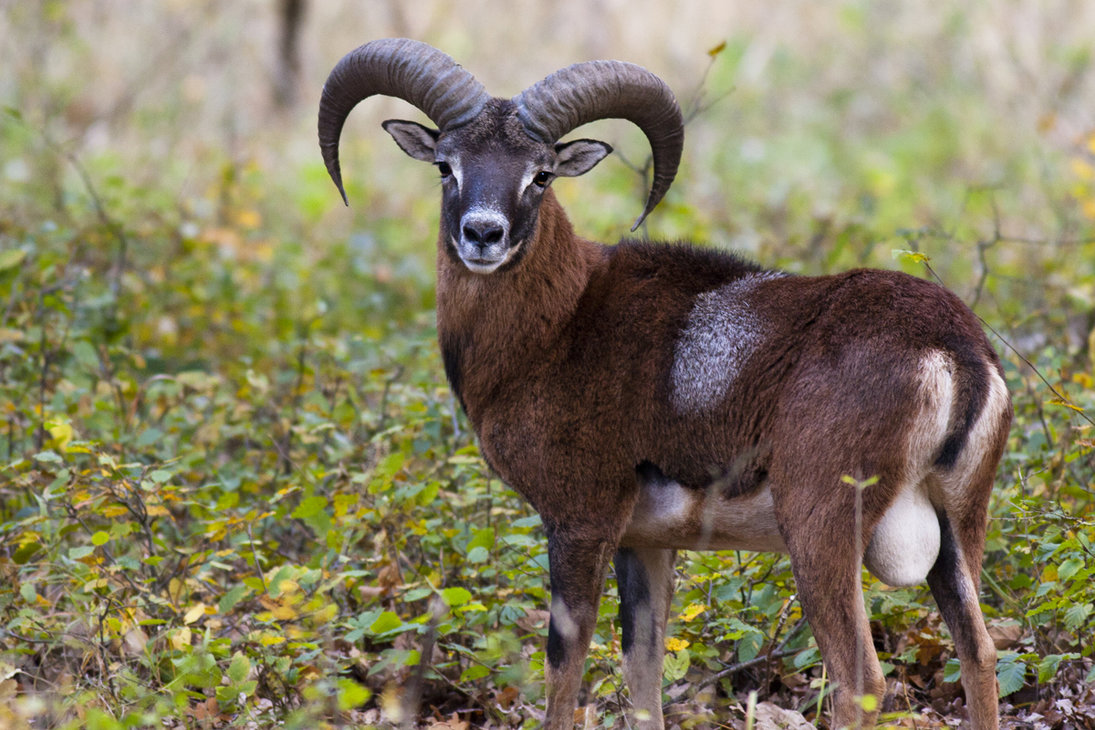
Sexual dimorphism shows in body size and in the male's horns. The horns have a characteristic shape. They are hollow and curled like a snail shell. The females have no horns. They are smaller than the males.
- Body length is 130–140 cm in males and 90–100 cm in females.
- Height is 70–80 and 60–70 cm respectively.
- Males weigh 40–45 kg, and females 30–35 kg.
In summer the mouflon is greyish brown, and in winter dark brown to black. In winter the coat is long, coarse and harsh, especially in males.
Distribution
It has been acclimatised in many European countries from its surviving natural populations on Corsica and Sardinia. It was introduced to many places in Bulgaria after 1960. It was brought to the Rhodopes in 1967, from Hungary. In 1971 and 1976 the population was reinforced with further imports, again from Hungary (10 mouflon) and then from Czechoslovakia (8 mouflon).
The mouflon lives in habitats with poor, dry soils and many rocky areas. It also does well on slopes and very steep ground.
Biology
It ruts in November and gives birth in March. The lambs are very lively: just a few hours after birth they can no longer be caught. In low temperatures and sudden cold snaps in March the lambs die.
The mouflon's horns grow throughout its life. After the eighth year they grow very little, and they begin to chip and wear away at the tips.
The mouflon's diet in Bulgaria has not been studied. It is known that besides herbaceous plants (mainly grasses), it also eats trees and shrubs.
Natural enemies
The wolf and the jackal are the main enemies of the mouflon. They kill mainly the lambs and the ewes, and they can strip a whole region of its game.
Economic importance
Mouflon numbers have fallen considerably in Bulgaria, including in the Rhodopes. The mouflon is a valuable resource species. Its meat is tasty, and the ease with which it can be bred in enclosures at high densities also makes it very productive.
Its trophy is valuable. In the wild in Bulgaria the mouflon is very wary and behaves like a wild animal, which makes it an interesting quarry. The national mouflon record is 240.05 points (Voden – Razgrad). The world record belongs to the Czech Republic – 252.45 points, taken in 1992. The largest trophy from the Rhodopes is 217.65 points, taken in 1980.