Name
Male deer are called stags, and females hinds.
Description
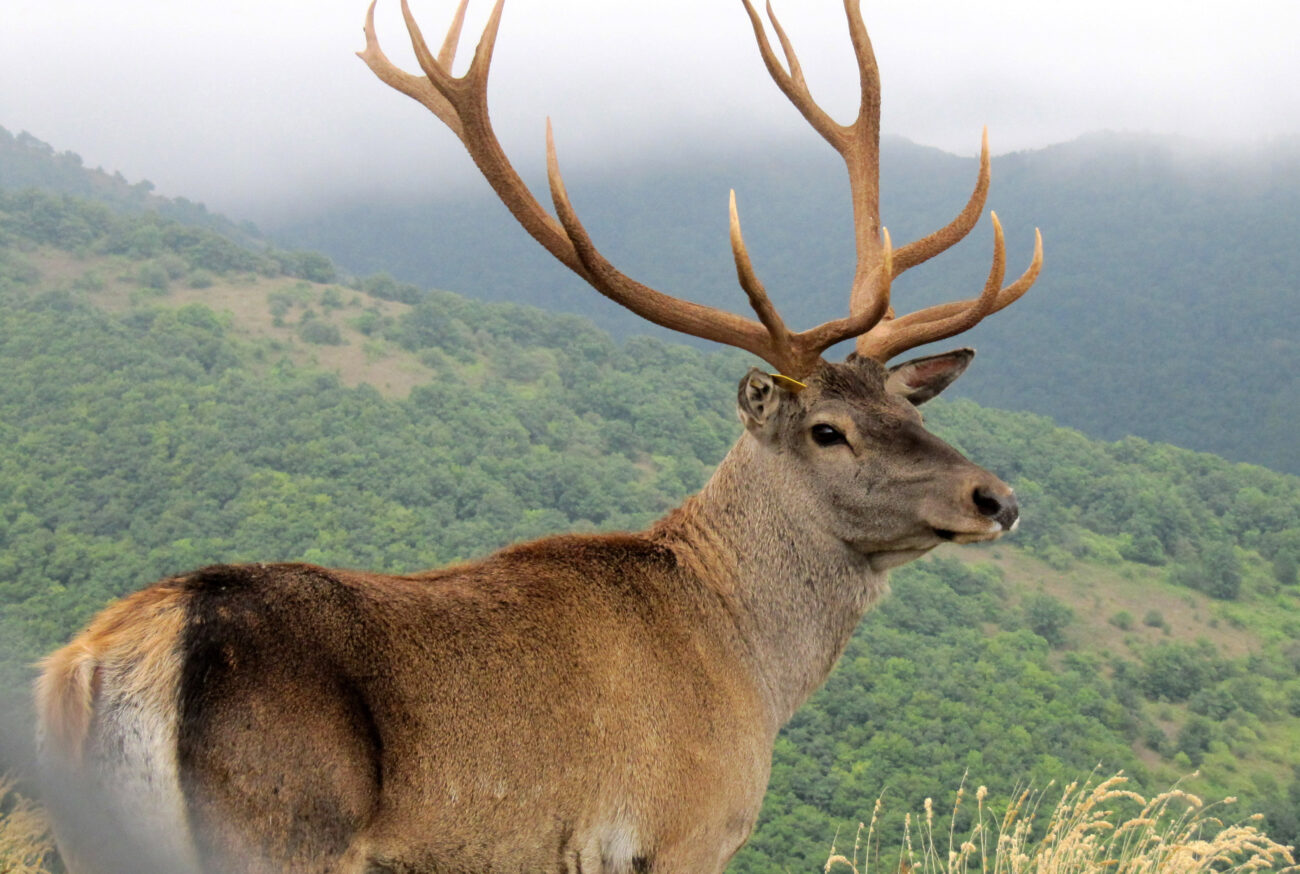
Stags have antlers (hence their Bulgarian name, rogachi, meaning the antlered ones), while hinds have none. Stags are larger than hinds.
- The body length of stags is 246.5 cm, and of hinds 187.2 cm.
- Stags stand 152 cm high on average, and hinds 118 cm.
- Mature stags usually weigh 150–180 kg, and hinds 110–130 kg. The heaviest stag weighed in Bulgaria was 235 kg, and the heaviest hind 210 kg.
Deer moult twice – in spring and in autumn. In summer their coat is reddish, and in winter greyish red.
Distribution
The red deer is found in Europe, Asia, North Africa and North America. In Bulgaria it had almost disappeared in the early 1930s. Today there are populations in the Rhodopes, albeit isolated ones, in almost every part of the mountains.
Biology
The red deer is polygamous. It ruts in September. Several stags roar close to one another in the same valley. Their mating call is an inimitable roar that impresses every nature lover and makes for an unforgettable experience. The hinds are active. They move among the stags and choose their mate. This is how each stag forms his harem. Strong stags often gather up to 7–8 hinds, and sometimes considerably more. The size of the rutting group depends on the population, the sex ratio and the mature stags available. With a normal age structure, young stags (up to 4–5 years old) are not allowed to mate. They roam around the rutting grounds, fight duels and are chased off with a triumphant roar. And so it goes until they themselves are able to defeat the old stag and take over his harem. The rutting fights are a unique spectacle.
Hinds give birth to one calf, more rarely two. The calves begin to move just a few hours after birth, and by the next day they can already run quite well.
A young deer grows its first antlers at the age of 9–10 months. It casts them before it turns two, and its second antlers begin to grow straight away. It carries these in the third year of its life and casts them before it turns three. Then the third antlers begin to grow, and so on. Each new set of antlers is more powerful and has more tines.
The red deer is a herd animal. In autumn the hinds and calves form large herds (of up to several dozen animals). They are led by the most experienced hind. Young stags that have not yet rutted also join these herds. In winter these herds can be seen in many places in the mountains.
Deer eat a wide range of plant food. In the Rhodopes the most important are grasses, followed by sessile oak, hawthorn, cornelian cherry, bramble and others.
Natural enemies
The natural enemies of deer are wolves.
Economic importance
The red deer is the most valuable game species in Europe. Bulgaria holds the finest trophies of the species. The largest trophy in the world to date – 273.60 points – was taken in north-eastern Bulgaria (Silistra area). In the Rhodopes the largest trophy is 223.53 points (Smolyan area). The red deer is also a source of tasty, high-quality meat. In meat production per unit of area, it is second only to the wild boar and the fallow deer.