Name
In Bulgarian the term diva svinya (wild pig) is used both as the name of the species and for the females, while the males are called gligani (boars).
Description
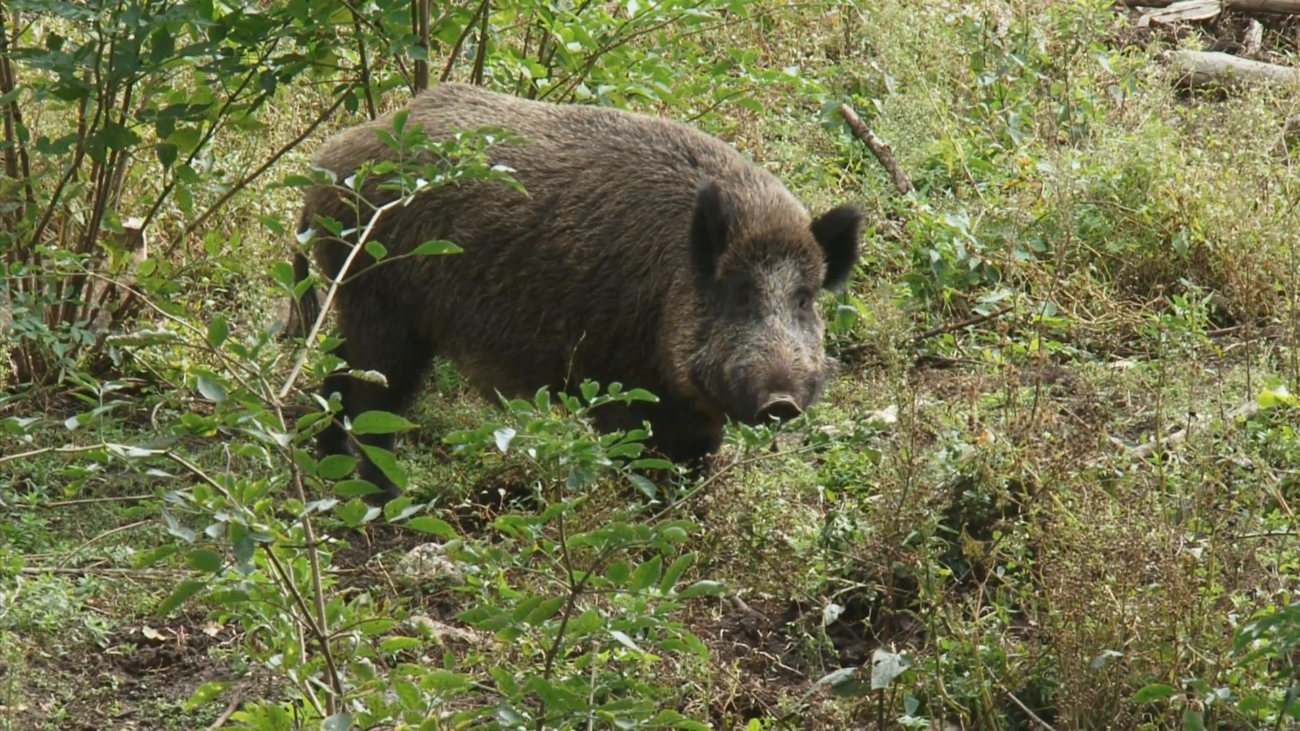
The wild boar is a large mammal.
- Body length is 160–180 cm in boars and 150–160 cm in sows.
- Height is 90–100 cm, in boars 70–80 cm, and in females 70-8- cm.
- Body weight varies within very wide limits. In Bulgaria adult, well-fed boars weigh 160–220 kg, rarely more, and females 110–140 kg.
- In boars over two years old the tusks can be seen.
The wild boar is greyish black in winter and greyish brown in summer. In winter the body is covered with long, coarse bristles. Beneath them there is a woolly underfur that insulates the body.
Distribution
The wild boar is found throughout Europe except Scandinavia and the northern parts of Russia.
In Bulgaria it occurs in all the country's forests, both lowland and mountain. It is a highly adaptable species, but whether it stays in a given habitat depends on the natural food available there. It keeps to mature oak and beech forests.
The wild boar is found everywhere in the Rhodopes. More than 5,000 wild boar live in the Rhodopes, over 10% of the country's total.
Biology
The wild boar usually gives birth to between 3 and 6 young. Until the age of six months the young are brown with light stripes along the body. They always move with their mother. The wild boar is one of the most caring mothers in nature. She pays particular attention to teaching her young to be cautious.
The wild boar is omnivorous. It eats almost anything of plant or animal origin that it can get at: the above-ground and underground parts of plants, the seeds and fruits of wild plants and crops, rodents, birds, eggs, young hares, carrion and all kinds of food waste.
The wild boar is a herd animal. The herds are formed by a mother with her young (this year's and last year's). Often 2–3 mothers come together to form a large herd of 15–20 animals. The boars move about alone. They join the herds only at night during the mating season. In the morning they leave the herd and rest somewhere nearby.
The wild boar is active at night. By day it rests in thickets and gets up only when forced to.
Natural enemies
The natural enemies of the wild boar are wolves and jackals. It is mainly the young that fall prey to these predators.
Economic importance
The wild boar is the most important game species as a resource. Thanks to its high rate of increase, it yields the most meat per unit of area, and thanks to its large numbers it offers exciting hunting to many hunters. This makes its trophy (the boar's tusks) especially valuable.
Bulgaria holds the world record for a wild boar trophy – 158.20 points, taken in the Rhodopes in 1986.