The first Slavic raids on the Balkan Peninsula began at the end of the 5th century and from the very start took on large proportions. Byzantium's efforts to stop the Slavs by force proved futile.
Lightly armed and experienced in warfare, the Slavic warriors almost always swept away in battle the far more numerous, armour-clad Byzantine troops.
A Byzantine treatise on the art of war from that time points out that ‘the Slavs liked to fight their enemies in wooded places, in gorges and ravines; they use ambushes, surprise attacks and ruses with great success, both by day and by night, devising all kinds of ways. They are also skilled at crossing rivers, surpassing all people in this respect’.
The Slavs gain the upper hand
By the beginning of the 6th century the balance of power was already on the side of the Slavs, and Byzantium gradually went on the defensive. It was then, to save at least the capital, Constantinople, that the Byzantine Emperor Anastasius ordered in 513 the building of a 70-kilometre wall from the Black Sea to the Sea of Marmara. A chronicler of the time rightly called this wall ‘a monument to cowardice’.
In the first half of the 6th century Byzantium strained all its forces in the struggle against the Slavs. Many attempts were made to stir up discord among the Slavic tribes. Some Slavic chieftains were also drawn into Byzantine service, as was the case with Chilbudius in 530. And when none of this helped, the empire turned to large-scale military building. All the old Thracian and Roman fortresses were restored. Many new ones were built as well.
Four fortified belts stretched across the Balkan Peninsula: along the southern bank of the Danube river, along the crest of the Balkan Mountains, in Sredna Gora and in the Rhodopes.
Building fortresses in the Rhodopes
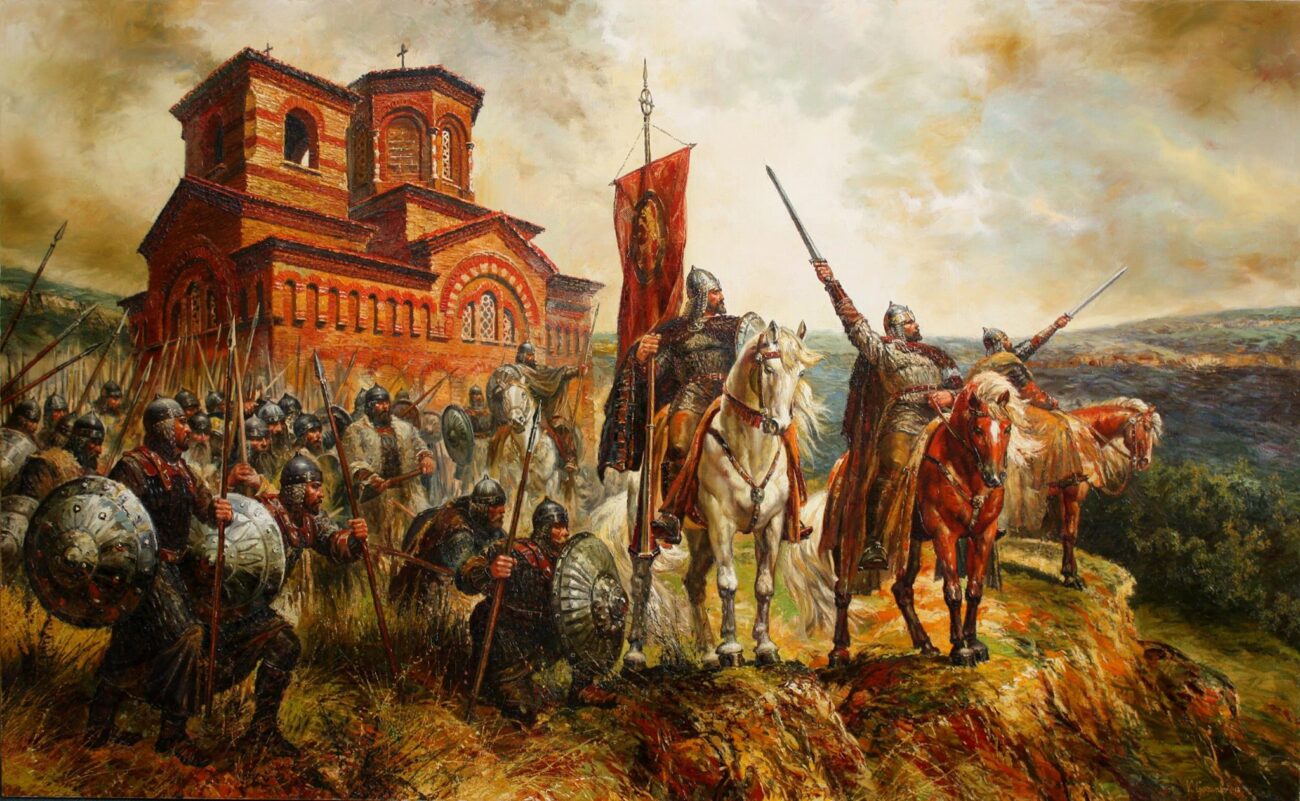
The building of fortifications in the Rhodopes shows that Byzantium saw this region as the last defensive system before the great cities of Thessaloniki and Constantinople. It is therefore no accident that some of the biggest battles raged in the foothills of the Rhodopes. Here, in the middle of the 6th century, the Slavs routed the elite army of the Byzantine Emperor Justinian, scattered the Byzantines a second time near Adrianople and pushed right up to the outskirts of Constantinople.
In the war with the Byzantines the Slavs perfected their fighting technique. Against the Byzantine fortifications they now came with battering rams, siege towers and other siege engines.
The great duel with Byzantium ended in the Slavs' favour. In 602 the empire's Danube defences finally collapsed, and over 10 years the Slavs settled in the Balkan Peninsula and the Aegean islands.
Support from the Thracians
The local Thracian population did not stand aside from this struggle. It passionately wanted to throw off foreign bondage, so it was wholly on the side of the Slavs and helped them most actively. In this way their joint struggle ended in success: the Slavs gained new lands to settle, and the Thracians threw off the Byzantine yoke.
The settlement of the Slavs
The settlement of the Slavs in the Balkan Peninsula is an event whose importance reaches far beyond the bounds of Bulgarian history. The Slavs destroyed the slave-owning order in the empire's European possessions. On the tips of their spears they brought freedom to the local population. The whole of south-eastern Europe was freed once and for all from the slave-owning system and gained the chance to move on to a more progressive social system – feudalism. Thus the Slavic settlement of the Balkan Peninsula played the role of an anti-slavery revolution.
At the same time the Slavs did not destroy Byzantium. Settling on its territory, they brought with them their social organisation – free village communities. This allowed the empire to recover quickly from its decline and to survive for another 10 centuries. And Byzantium, as is well known, preserved the achievements of ancient culture and passed them on to modern times. In this way the Slavs also have undoubted merit with regard to the culture of all humankind.
Peaceful coexistence
The Slavs and the Thracians came to live together in harmony. From the Thracian population the Slavs took over a number of achievements of Roman and early Byzantine culture, mastered many new crafts and adopted some Thracian customs. The Thracians, for their part, being fewer in number, merged into the huge Slavic mass. The Balkan Peninsula became Slavic, and the Bulgarian Slavs became the heirs and continuers of Thracian culture.
The same thing happened in the Rhodopes. The greater part of the Rhodopes was settled by the Smolyani. After them, the territory they inhabited (the whole of the Western and Central Rhodopes), together with part of the Aegean coast, later received the name of the Smolyani Region. Soon the local Thracian population was assimilated, and Slavic speech rang out across the whole mountain. The Rhodopes became a purely Slavic region.
The next article continues with the Proto-Bulgarians.